
Initiatives
Tarium Niryutait Marine Protected Area
Pronunciation Sound Clip
The Tarium Niryutait Marine Protected Area (TN MPA) was officially announced on August 26th, 2010. It is Canada’s first Arctic MPA and consists of three sub-regions: Niaqunnaq, Okeevik, and Kittigaryuit. Together, these three areas cover approximately 1,750 square kilometres of the Mackenzie River Delta and Estuary in the Beaufort Sea.
TN MPA was created through a collaborative effort by Fisheries and Oceans Canada (DFO), Inuvialuit, private industry, local stakeholders, and other government departments. TN MPA is part of Canada’s expanding network of protected and conserved ocean areas to help manage Canada’s ocean’s resources.
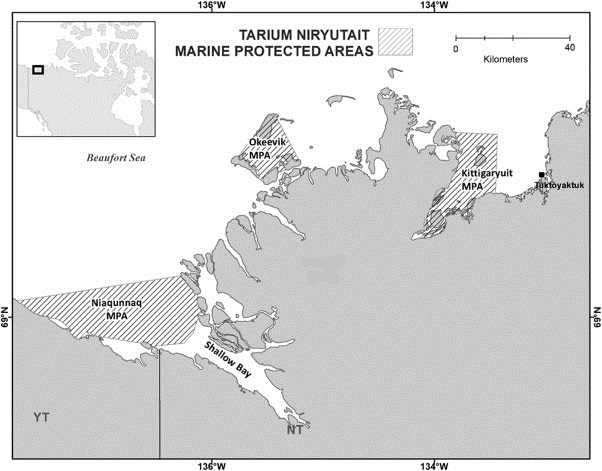
The purpose of the TN MPA is to conserve and protect the biological resources within the MPA and to support the viability of a healthy population of beluga whales. This area is particularly important to the Beaufort Sea beluga whale stock that travels to the Mackenzie Estuary during the summer months. These whales come to this area for feeding, rearing calves, moulting, socializing, and energetics (i.e. thermal advantage).
TN MPA has traditionally been used by the Inuvialuit and it is important for cultural, subsistence, and economic purposes. A socio-economic assessment was conducted in the early stages of MPA discussions and the resulting MPA was designed to balance Inuvialuit cultural and economic priorities while also advancing the Government’s environmental conservation objectives. It does this by protecting harvesting traditions central to the Inuvialuit culture in the communities of Aklavik, Inuvik, and Tuktoyaktuk.
The key objectives of the TN MPA are:
- To conserve and protect beluga whales and other marine species (i.e. anadromous fish, waterfowl, and seabirds), their habitats, and their supporting ecosystem;
- To ensure the long-term sustainable management of one of the world’s largest summering stock of beluga whales and their habitat;
- To preserve the harvesting traditions of the Inuvialuit people in the Inuvialuit Settlement Region; and,
- To prohibit specific activities or classes of activities that could potentially negatively impact beluga or any part of the ecosystem in the areas upon which they depend.
To learn more about the TN MPA, including its annual reporting and regulations, please visit the Research and Publications tab on the DFO TN MPA main website:
For information regarding the Socio-Economic Assessment please refer to the following report: